
Kinesio-Taping
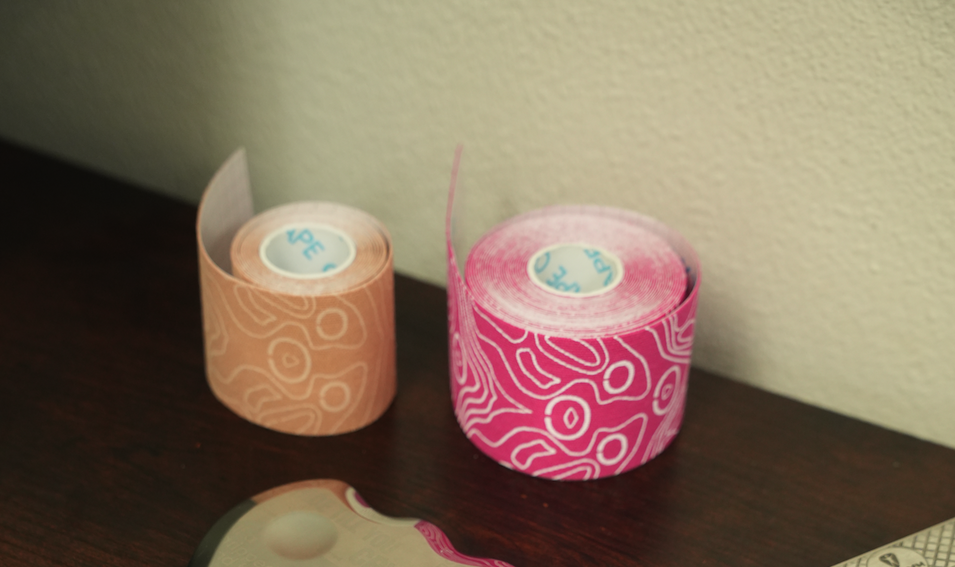
You're getting better — but your body keeps falling back into the old pattern.
The adjustment helped. The soft tissue work released something that's been locked up for weeks. You stood up and for the first time in a while, things actually felt different. Looser. More open. More balanced.
Then you went home. Sat at your desk. Slept in your usual position. Trained the next day. And within 48 hours, your body started creeping right back to where it was — because your nervous system has been running the old pattern for so long it doesn't know how to hold the new one yet.
That's not a treatment failure. That's a patterning problem. And that's exactly where taping fits.
Kinesio tape is a neurological cue, not a brace.
Most people think of tape as something that holds a joint in place or compresses swelling. That's athletic tape. Kinesio tape does something fundamentally different.
It's elastic. It stretches and recoils with your skin. And because of that, it creates a constant low-grade sensory input to the area it's applied to — a subtle tug on the skin that your brain can't ignore. Every time you move, the tape gently pulls on the underlying mechanoreceptors and tells your nervous system: this area matters right now. Pay attention to it.
That input changes how your body organizes movement around that area. It can reduce pain by competing with nociceptive signals. It can facilitate a muscle that's not firing well by giving it a proprioceptive boost. It can inhibit a muscle that's overworking by changing the tension pattern across the skin. And it can improve lymphatic drainage by microscopically lifting the skin to create space for fluid to move.
It's not magic. It's not holding anything together. It's a sensory reminder that extends the work we did in the treatment room into the hours and days between visits.
How we actually use it.
We don't tape for show. Every application has a specific clinical intention:
To reinforce a correction. After an adjustment or soft tissue session, we'll tape in a way that supports the new position or movement pattern. If we just spent 30 minutes getting your shoulder blade to sit properly and your thoracic spine to extend, the tape helps your nervous system remember that position while you go about your day. It bridges the gap between what we did on the table and what your body can maintain on its own.
To calm down an irritated area. When a muscle or tendon is inflamed or hypersensitive, certain taping techniques reduce the mechanical load on that tissue. The tape takes a small percentage of the strain off the structure — not enough to replace its function, but enough to bring the pain level down and let you move more normally while it heals.
To improve muscle activation. Some muscles aren't weak — they're neurologically quiet. They've been inhibited by pain, posture, or compensation so long that your brain has stopped recruiting them efficiently. Tape applied along the direction of muscle contraction gives that tissue a proprioceptive nudge. It doesn't make the muscle fire. It makes the muscle easier for your brain to find.
To manage swelling and bruising. Fan-cut or web-pattern tape applied over a swollen area creates microscopic channels between the skin and the underlying fascia. These channels improve lymphatic flow and accelerate the clearance of fluid and metabolic waste. This is especially useful post-injury, post-surgery, or after an aggressive soft tissue treatment.
What we tape for.
Postural correction support between treatment sessions
Shoulder instability or scapular dyskinesis
Neck and upper trap overactivity
Low back pain and SI joint irritation
Knee tracking issues and patellar tendon support
Plantar fasciitis offloading
Acute muscle strains or bruising
Post-surgical swelling management
Achilles and elbow tendon issues
Any area where we need the treatment to last longer than the session
What taping won't do.
Tape is not a fix. It doesn't replace an adjustment. It doesn't replace corrective exercise. It doesn't replace actually addressing the thing that's causing your problem. If someone puts tape on you and sends you home with no plan, the tape is doing the job the rest of the treatment should have done.
We use it as an extension of treatment — not a substitute. Think of it as the last five percent that helps the other ninety-five percent stick. It keeps your body honest between visits so the work we're doing compounds instead of resets every time you walk out the door.
What to expect.
Application takes a few minutes at the end of your session. The tape stays on for 2–5 days depending on the area and how active you are. You can shower with it, train with it, sleep in it. It'll start to peel at the edges as it wears, and you just remove it when it's done.
Some people feel the effect immediately — especially when it's used to offload a painful area or facilitate a weak muscle. Others notice it more passively. They realize partway through the day that they're sitting differently, moving more freely, or that the thing that usually flares up by 3pm just... didn't.
The point of the tape is to make itself unnecessary.
Good taping should work itself out of a job. As your body learns the new pattern, holds the correction, and builds the strength to stabilize on its own — the tape becomes less necessary. If you're still relying on tape months later with no change in the underlying problem, the tape isn't the issue. The plan is.
We use it because it works. But we use it with the intention of not needing it.