
Shockwave Therapy
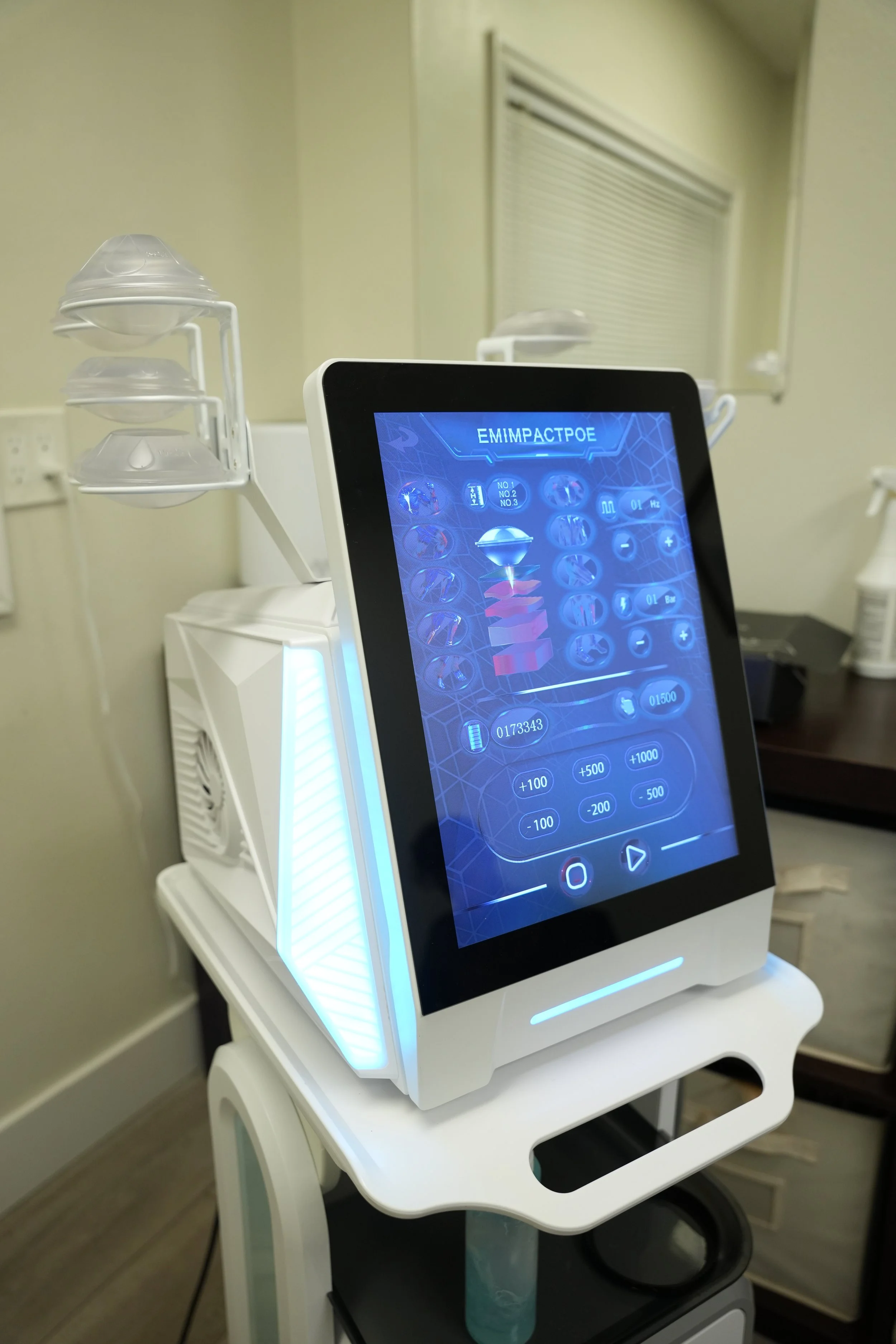
You've already tried the basics.
You've rested it. You've stretched it. You've iced it, foam rolled it, maybe even gotten a few massages or injections. And it helped — for a little while. But that nagging pain in your heel, your shoulder, your elbow, your knee? It's still there. Maybe not as sharp as it was at first, but it's there every morning, every workout, every time you push it. It's the kind of injury that doesn't stop your life — it just slowly shrinks it. You stop running. You modify your workouts. You start "managing" it instead of fixing it.
That's not a plan. That's a slow surrender.
Shockwave therapy is for the stuff that won't finish healing.
It's one of the most effective treatments available for chronic tendon and soft tissue injuries — the kind that plateau and just linger. If you've been dealing with something for weeks or months and it's stalled out, shockwave is designed for exactly that.
We're talking about:
Plantar fasciitis that ruins your first steps every morning
Achilles tendon pain that won't let you push off properly
Tennis or golfer's elbow that flares every time you grip something
Shoulder tendinopathy that's been "almost better" for six months
Patellar tendinitis that's taken running or jumping off the table
Chronic tight spots and trigger points that keep coming back no matter how much bodywork you get
These aren't injuries that need more rest. They need a stronger signal.
Here's what's actually happening in the tissue — and why it matters.
When a tendon or soft tissue structure stays irritated long enough, the body stops actively healing it. Instead, it lays down disorganized scar tissue, blood flow to the area decreases, and the tissue enters a chronic, degenerative state. It's not inflamed anymore — it's stalled. That's why anti-inflammatories and rest stop working. You're treating inflammation that isn't there anymore.
Shockwave therapy delivers focused acoustic pressure waves directly into that tissue. This does three things: it increases local blood flow, stimulates the release of growth factors, and breaks down the calcific and fibrotic buildup that's keeping the tissue stuck. It essentially forces the area to re-enter an active healing phase — taking it from a tissue that's given up to one that's repairing again.
It's not ultrasound. It's not a TENS unit. It's a real mechanical stimulus that creates a real biological response.
What a session feels like.
Treatment takes about 5–10 minutes on the affected area. You'll feel strong, rhythmic pulsing — it's intense but manageable. Areas with more damage tend to be more sensitive at first, which actually helps us zero in on exactly where the problem is. Most people describe it as a deep tapping sensation that eases up as the tissue responds.
No downtime. You walk out and go about your day. We may ask you to avoid heavy loading on the treated area for 24–48 hours, but that's it.
How long until you feel a difference.
Most conditions respond within 3–6 sessions, about a week apart. Some people feel a shift after the first visit. For others, it kicks in around session two or three as the tissue remodeling builds momentum.
We don't use shockwave in isolation. It's part of a treatment plan — combined with hands-on work, corrective exercise, or other therapies depending on what's driving your issue. The goal isn't to numb the pain. It's to change the tissue so the pain doesn't have a reason to exist anymore.
If this sounds like what you've been dealing with — let's take a look.
Book an appointment and we'll assess whether shockwave is the right fit for your situation. No pressure, no commitment to a package. Just an honest evaluation and a real plan.