
Manual Muscle Therapy
The tightness that won't go away isn't what you think it is.
You stretch and it comes right back. You foam roll and it loosens up for an hour. You get a massage and by the next morning it's like you never went. That locked-up feeling in your neck, your upper back, your hips — it's not just a "tight muscle." If it were, stretching would have fixed it by now.
What you're actually dealing with is a fascial problem. And until someone addresses it at that level, you're going to keep chasing the same tightness in circles.
So what is fascia — and why does it matter?
Fascia is the connective tissue that wraps around and between every muscle, joint, nerve, and organ in your body. Think of it like a full-body web — when it's healthy, everything slides, glides, and moves independently. When it's not, things stick together. Layers that should move freely start gripping. Muscles that should fire independently start pulling on each other. And you feel it as stiffness, restriction, knots, and pain that doesn't seem to have an obvious cause.
This happens from overuse, underuse, repetitive postures, old injuries, inflammation, and just the wear and tear of living in your body. The fascia thickens, adheres, and stops doing its job. And no amount of stretching is going to fix an adhesion. You have to release it.
That's what myofascial release does — and we use multiple tools to get there.
Myofascial release isn't one technique. It's an approach. The goal is always the same: restore normal sliding between tissue layers, break up adhesions, increase blood flow, and give the nervous system permission to let go. How we get there depends on where the restriction is, how deep it runs, and what your body responds to best.
Here's what we use and why:
Manual Myofascial Release (Hands-On)
This is the foundation. Slow, sustained pressure applied directly into the restricted tissue — held long enough for the fascia to soften, stretch, and release. It's not a Swedish massage. There's no flowing rhythm. Your therapist finds the restriction, engages it, and waits for the tissue to change under their hands.
This is particularly effective for broad, deep restrictions — the kind that live in your thoracic spine, your hip complex, your IT band, or your neck and suboccipital region. It's also the most precise. Skilled hands can feel what a tool can't — subtle shifts in tissue tension, guarding patterns, the exact moment a layer releases.
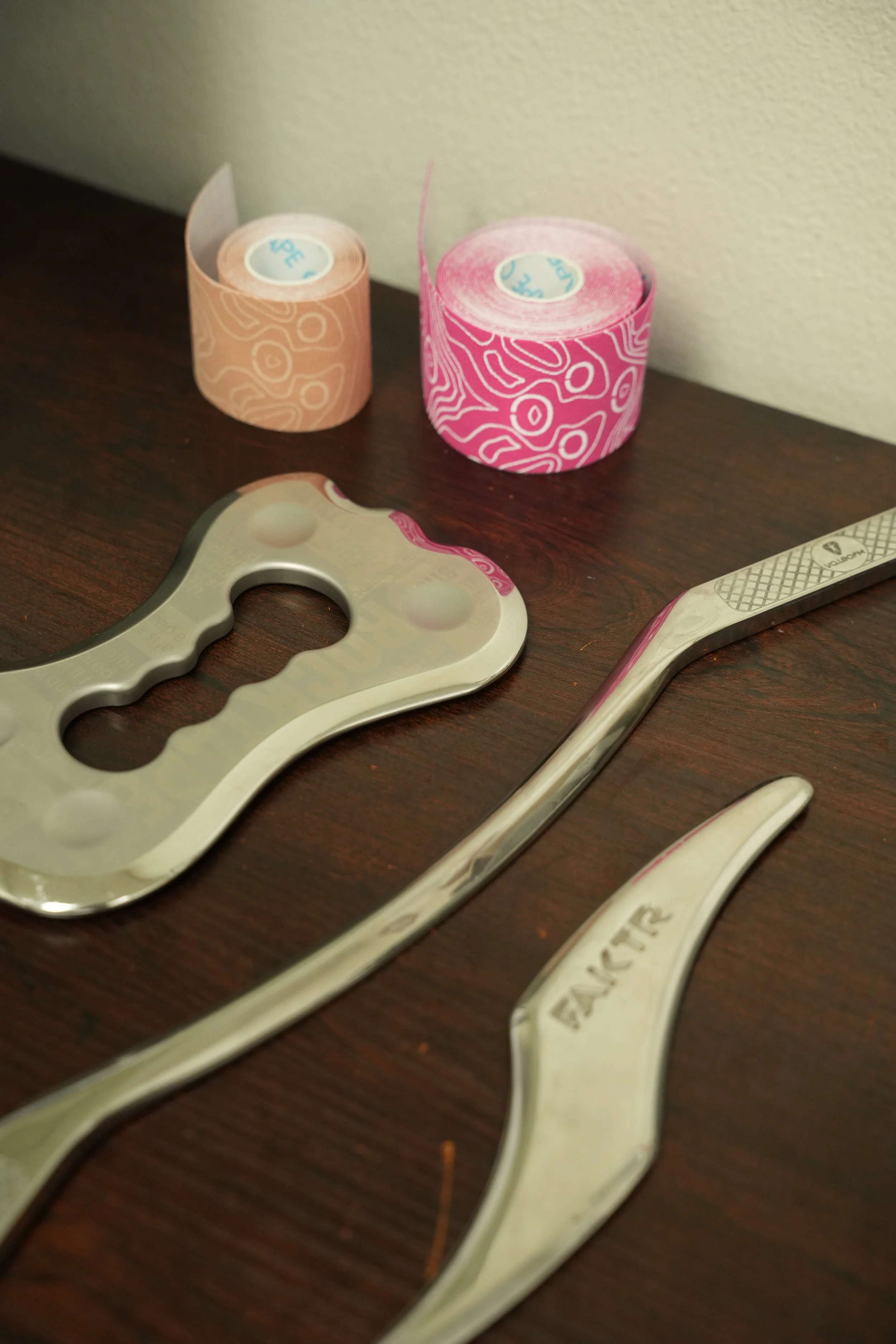
Instrument-Assisted Soft Tissue Mobilization (Scraping / IASTM)
A stainless steel or hard-edge tool is used to scan and treat the tissue surface with controlled pressure and motion. The tool amplifies what the clinician can feel — picking up texture changes, fibrotic buildup, and adhesions that hands alone might miss. It also delivers a more focused, intense stimulus to the tissue.
You'll hear people call this Graston, Gua Sha, or just "scraping." The name doesn't matter. What matters is that it creates a controlled microtrauma at the fascial level — breaking up disorganized collagen and scar tissue, increasing local blood flow, and triggering a fresh healing response.
This works especially well on tendons, tendon attachments, and superficial fascial layers — areas like the forearm (elbow issues), the Achilles, the plantar fascia, the IT band, and the upper traps and levator scapulae. It's also effective on old scar tissue from surgeries or injuries that never fully remodeled.
It's intense. You'll likely see some redness or mild bruising. That's a normal inflammatory response — it means the tissue is responding.
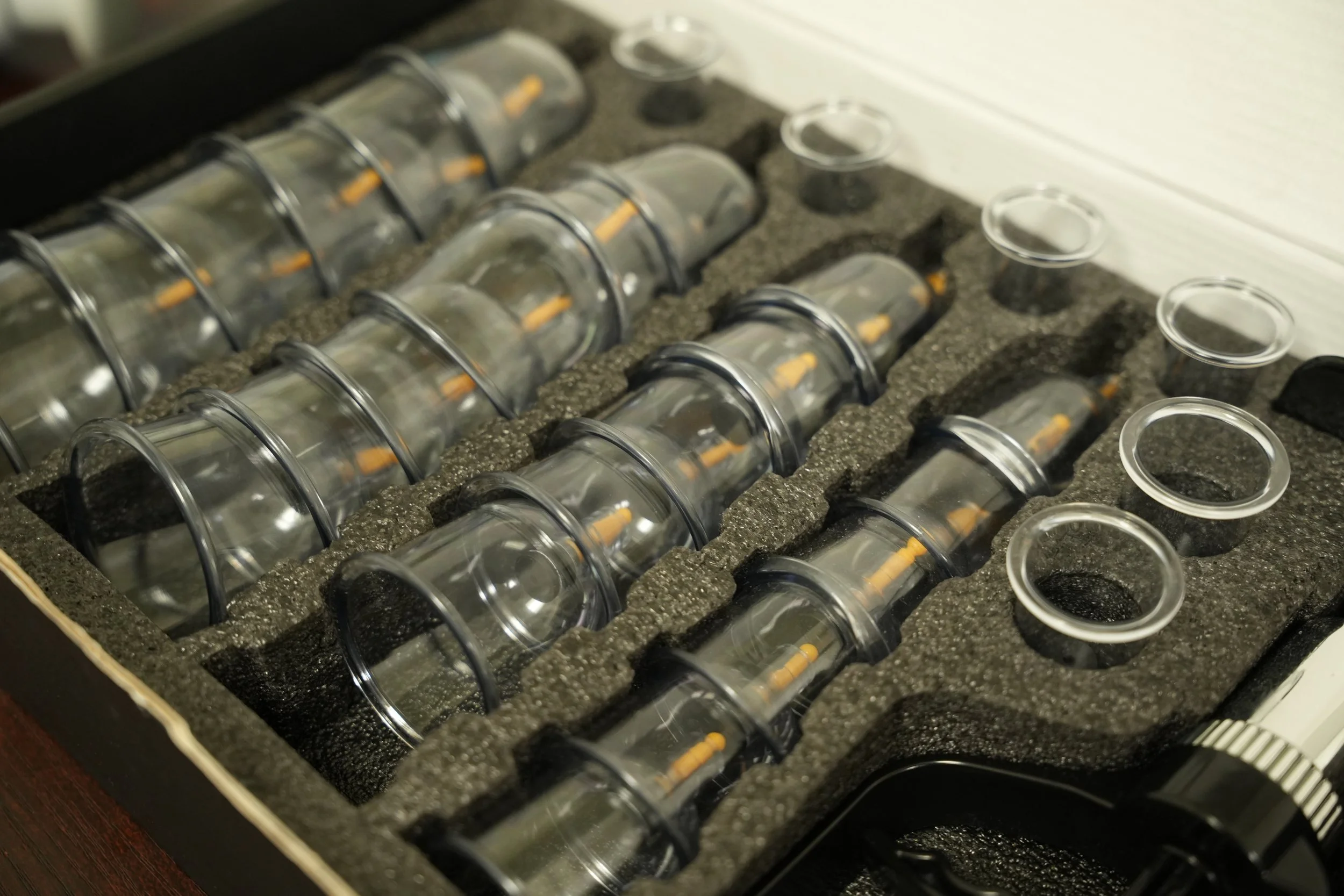
Cupping
Cupping uses suction to lift and decompress tissue rather than pressing into it. While most manual techniques push down, cupping pulls up — separating fascial layers, drawing blood into the area, and creating space where there was restriction.
This is especially useful for areas that are highly guarded or sensitive to direct pressure. A lot of patients who can't tolerate deep manual work on their upper back or neck respond really well to cupping because it achieves a similar fascial release through a completely different mechanism. It also works well for broad areas of tension — the kind that feel like a sheet of stiffness rather than a single knot.
We use both stationary cupping (placed and held on specific areas) and dynamic cupping (moved across the tissue with glide) depending on what we're targeting. You'll feel a strong pulling sensation. Some areas will mark more than others — the discoloration tells us where the tissue was most congested. It fades within a few days and it's completely normal.
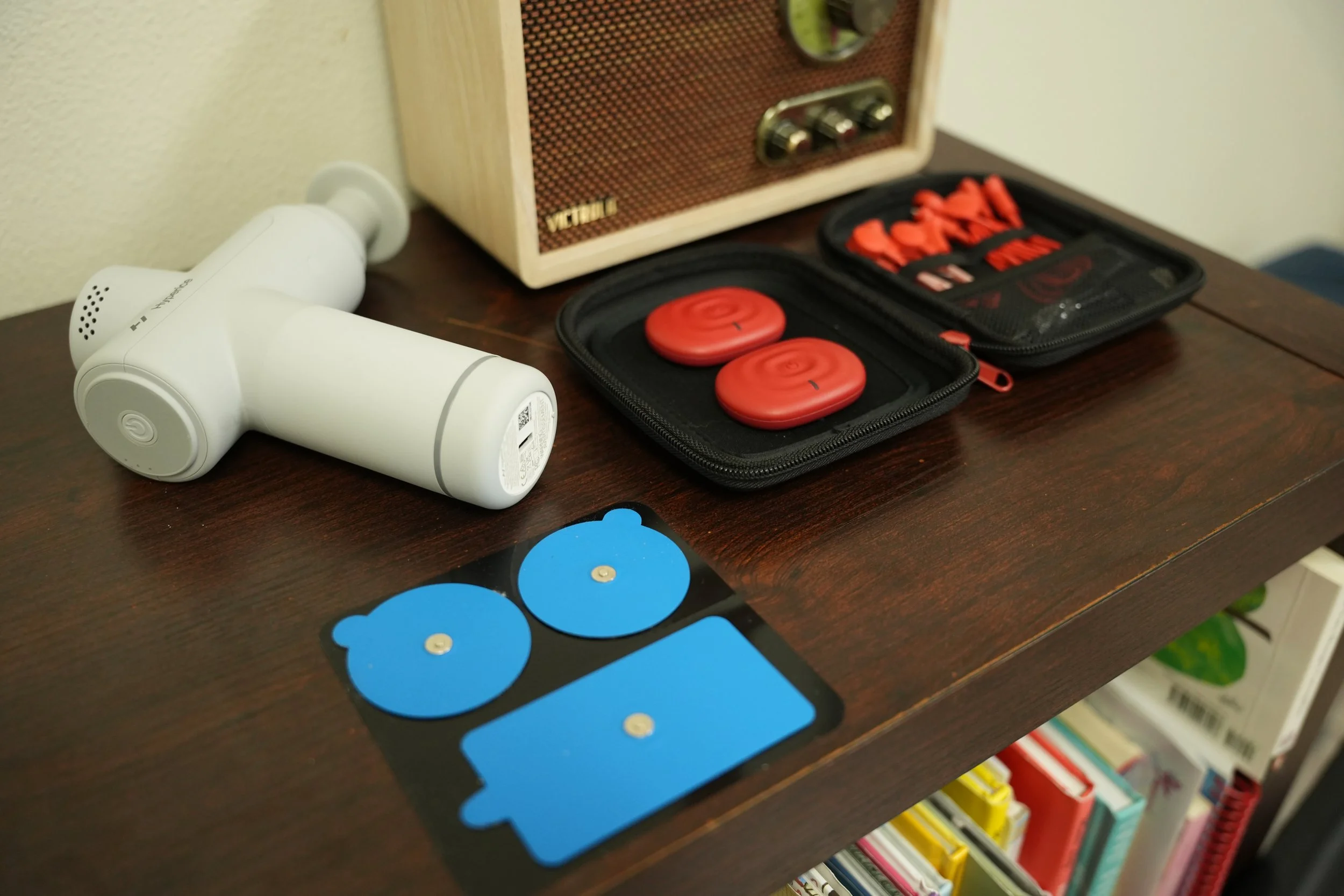
Percussive Therapy (Massage Gun)
The massage gun delivers rapid, targeted percussive pulses into muscle and fascia. It's fast, rhythmic, and hits a different part of the nervous system than slow manual work.
Where manual release works by sustained pressure and tissue creep, percussion works by rapidly cycling the muscle through contraction and relaxation at a speed the nervous system can't keep up with. The result: the muscle lets go. Tone drops. Blood flow increases. And the tissue becomes more receptive to deeper manual or instrument-assisted work that follows.
We use it strategically — often as a warm-up to prime tissue before manual release or scraping, or as a targeted tool for specific areas like a locked-up QL, a hypertonic piriformis, or stubborn trigger points that need a different input to release. It's not a substitute for skilled hands-on work, but it's a powerful complement that makes everything else more effective.
Why we layer these together instead of relying on just one.
Every one of these tools accesses the fascial system differently. Manual release works through slow, sustained load. Scraping creates mechanical shear across tissue layers. Cupping decompresses and separates. Percussion overrides neurological guarding.
A restriction that won't budge under hands alone might release immediately once you decompress it with cupping first. A tendon that's too reactive for scraping might need percussion to calm the tone down before you can work it effectively. The combination is the point. We assess what's going on and choose the right tool — or sequence of tools — for the tissue we're dealing with that day.
This is also why "just getting a massage" often doesn't solve the problem. A general massage treats muscles. Myofascial release treats the system those muscles live inside. If the fascial web is stuck, the muscle has no choice but to stay tight. Release the fascia, and the muscle can finally do what stretching's been trying to make it do for months.
What we treat with myofascial release.
Chronic neck and upper back stiffness that won't resolve with stretching
Headaches driven by suboccipital and cervical fascial tension
Shoulder restriction and impingement-type pain
Low back stiffness and recurring muscle guarding
IT band syndrome and lateral knee pain
Plantar fasciitis and Achilles tendon issues
Post-surgical scar tissue that limits mobility
Hip tightness and deep gluteal tension
Chronic trigger points that keep returning despite treatment
General "I feel locked up and nothing seems to fix it"
What to expect.
Sessions vary depending on what we find. Some areas respond quickly — one session and the tissue shifts. Others take a few visits to unwind, especially if the restriction has been building for months or years. You'll likely feel sore afterward, similar to a hard workout. That settles within a day or two, and what follows is movement that feels noticeably different — freer, lighter, less guarded.
We don't use these tools randomly. We assess, we identify where the restriction lives and what's driving it, and we build a plan that matches. This might be a standalone session or part of a broader treatment protocol with other therapies. Either way, the goal is the same: get your tissue moving the way it's supposed to so your body stops fighting itself.
If nothing else has worked — it might not be a muscle problem.
Book an appointment and let us assess what's going on. If it's fascial, we have the tools to fix it. If it's something else, we'll tell you that too.