
Chiropractic Adjustments
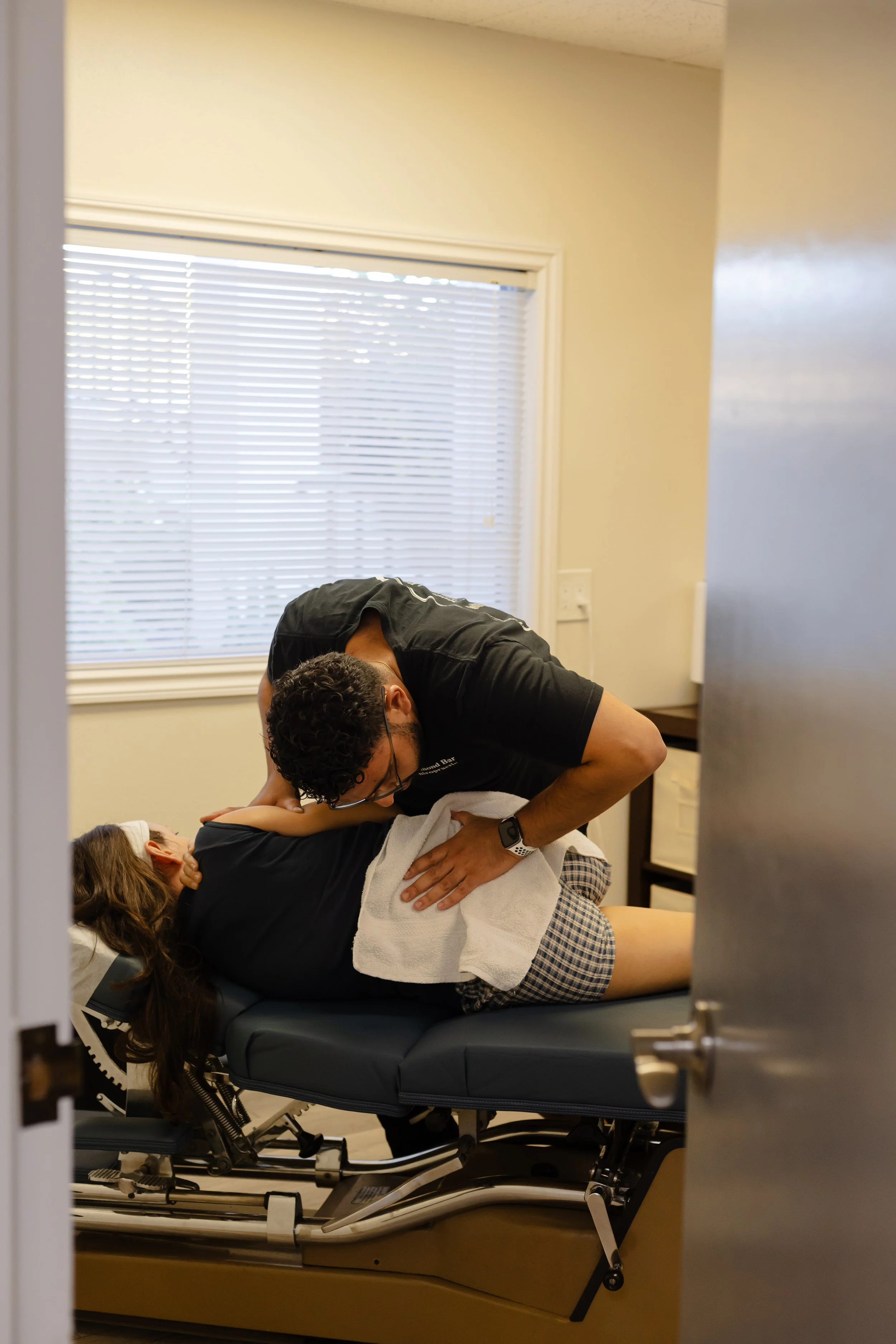
That stiff, stuck, "I can't turn my neck" feeling? Your joint isn't moving the way it should.
You wake up locked up. You can't rotate without pain. Your low back seizes every time you bend. Your mid-back feels like it's fused into one solid block. You've been stretching, rolling, cracking your own knuckles and neck trying to get relief — and maybe you get a pop here and there, but the restriction comes right back.
The problem isn't just muscle tension. It's that one or more joints in your spine have lost their normal movement. And when a joint doesn't move properly, everything around it compensates — muscles guard, fascia tightens, nerves get irritated, and your brain starts routing movement around the problem instead of through it.
That's what an adjustment fixes. Not the sound. Not the "alignment." The movement.
Let's clear something up first.
There's a lot of confusion and frankly a lot of tribalism around spinal manipulation. So here's the truth: the high-velocity, low-amplitude (HVLA) thrust technique that chiropractors use is the same technique used by doctors of osteopathy (DOs) and physical therapists who are trained in manual therapy. Same biomechanics. Same neurophysiology. Same clinical reasoning. Different license, same intervention.
DOs call it osteopathic manipulative treatment. PTs call it spinal manipulation. Chiropractors call it an adjustment. The technique itself doesn't change because the title on the door does.
The difference isn't what we do — it's how often, how well, and in what context we do it. In this clinic, an adjustment isn't a standalone ritual you come in for three times a week forever. It's a precise tool used when a joint isn't moving, applied with clinical reasoning, and integrated into a broader plan that addresses why the joint got stuck in the first place.
What actually happens during an adjustment.
An HVLA thrust is a quick, controlled push through a joint's restrictive barrier. It's specific — we're targeting one segment, one direction, one fixation. The "pop" you hear is a cavitation — a gas release inside the joint capsule as pressure changes. It's the same thing that happens when you crack your knuckles. It feels satisfying, but the sound itself isn't the treatment.
Here's what the thrust actually does:
The rapid stretch of the joint capsule fires a cascade of mechanoreceptors — sensory nerves that tell your brain where your body is in space and how it's moving. That input floods the nervous system with new proprioceptive data, which overrides the pain-guarding loop that was locking the joint down. Muscle tone around the segment drops almost immediately. Local blood flow increases. Range of motion restores.
It's not "putting a bone back in place." Your vertebrae aren't out of position. They're neurologically locked. The adjustment resets the input, and the nervous system releases the brake.
That's why the relief is often instant. It's not a structural change — it's a neurological one. And that distinction matters because it changes how you should think about the purpose of an adjustment. It's not correcting something that's broken. It's restoring a signal that got interrupted.
What we treat with adjustments.
Acute neck stiffness and cervicogenic headaches
Mid-back restriction and thoracic immobility
Low back pain with segmental hypomobility
SI joint dysfunction
Rib fixations that cause sharp pain with breathing or rotation
Movement compensations driven by joint restrictions elsewhere in the chain
Post-exercise or post-travel stiffness where specific segments have locked up
What an adjustment doesn't do — and why that matters.
An adjustment restores joint motion. That's its job. What it doesn't do is strengthen the muscles that should be stabilizing that joint, correct the postural habits that locked it up, or resolve the fascial restrictions that may be pulling it out of its normal movement pattern.
This is where a lot of chiropractic care goes sideways — not because the adjustment doesn't work, but because it's used as the only tool. If you adjust a joint but never address the reason it keeps fixating, you'll need to be adjusted again next week. And the week after that. And the week after that.
We don't run that model. If you need an adjustment, you'll get one. But you'll also get an honest conversation about what's driving the dysfunction — and a plan that includes soft tissue work, corrective exercise, or whatever else is necessary to make the adjustment hold.
The goal isn't to make you dependent on being adjusted. It's to get the joint moving, figure out why it stopped, and fix the pattern so it doesn't keep happening.
What to expect.
Adjustments are quick. The setup and assessment take longer than the thrust itself. You may feel immediate relief, or you may feel a bit sore as the surrounding musculature adapts to the new range of motion — similar to how you'd feel after a deep stretch you haven't done in a while. That soreness settles fast, usually within a day.
Some people need one adjustment to resolve an acute fixation. Others benefit from a short series — especially if the restriction has been present for weeks or months and the surrounding tissue has adapted to the dysfunction. We'll tell you what we think is appropriate and why.
If you've been on the fence about chiropractic — or you've had a bad experience elsewhere.
We get it. There's a wide spectrum out there. Some of it is excellent. Some of it is oversold. If you've been told you need to come in three times a week for the foreseeable future without a clear reason — that wasn't the adjustment that failed you. It was the model.
Come in. Let us assess what's going on. If an adjustment is the right call, we'll do it and explain exactly why. If it's not, we'll tell you that too.